
Bending the Clock – Crip Time, Queer Time & the Art of Becoming
29. August, 11:00 - 18:00
Kostenlos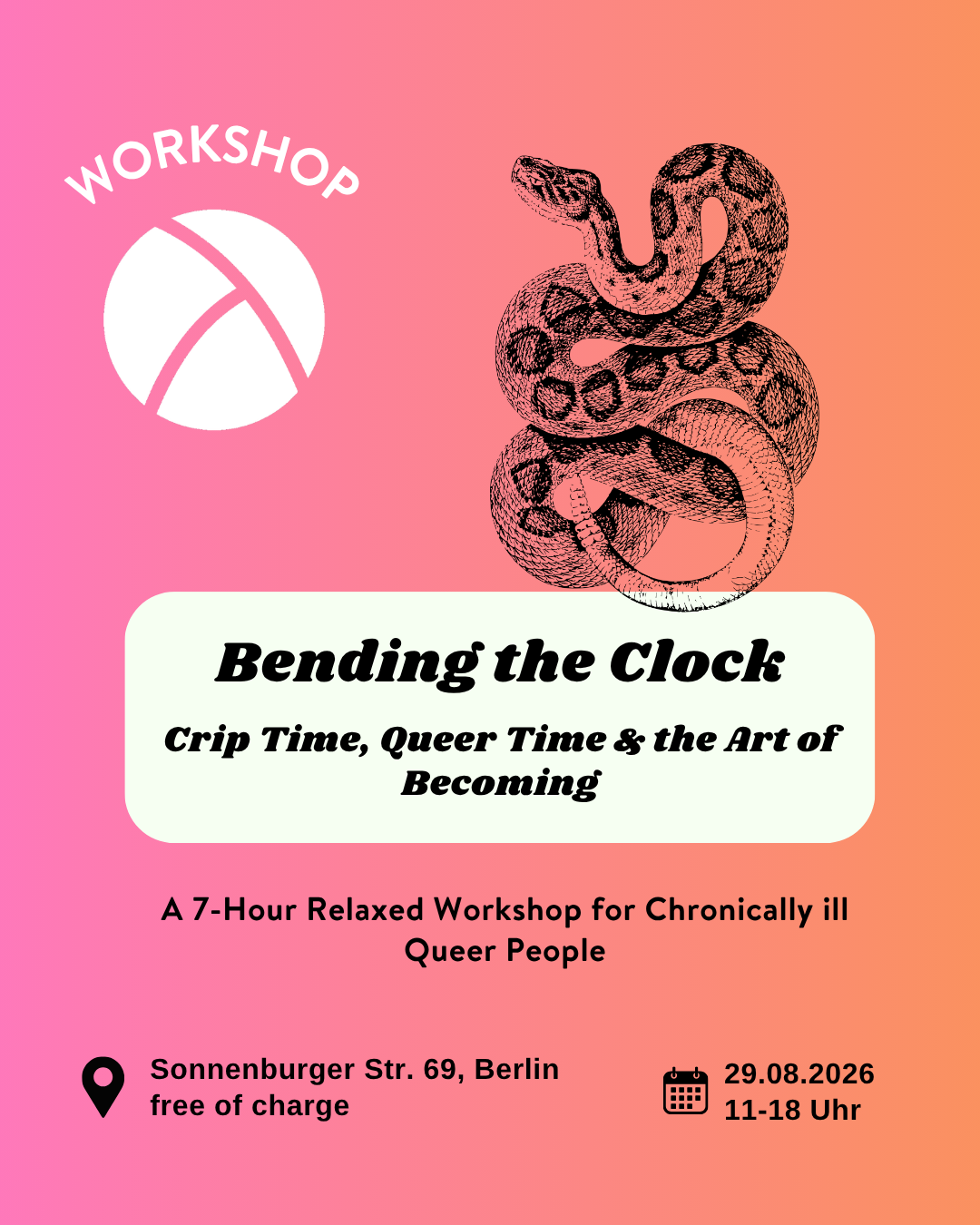
A 7-Hour Relaxed Workshop for Young Chronically Ill Queer People
This is a full-day participatory workshop for people who live at the intersection of
chronic illness and queer identity. Through a combination of facilitated dialogue, short slide-
based inputs, and gentle hands-on making activities, we will explore the concept of
crip time alongside queer time — and what it means to imagine a future on our own terms.
The workshop is grounded in care and slowness. There is no product to deliver, no
performance to give, and no correct way to participate. The only thing that matters is what
happens between people in the room.
What does it mean to imagine a future when the dominant culture has already decided you don’t belong in it?
This workshop sits in that question — not to answer it, but to hold it together, in community.
A relaxed event
Relaxed events are designed to welcome people who may find a standard workshop format
inaccessible, overstimulating, or difficult to sustain. In practice this means:
- There is no pressure to stay the whole day, or participate in every
activity. - Participants may move around, step out, lie down, or take breaks without
explanation. - The space will be kept as quiet and calm as possible. Noise levels and lighting will be
discussed with everyone at the start. - Support needs are welcomed, not just accommodated. If you need something, you
can ask. - Language, including the language used to describe disability and queerness, will be
handled with care. No one will be expected to use terminology they are not
comfortable with. - There are no experts in the room. The facilitators are also chronically ill and queer, and
shares this space as a peer.
The relaxed format is not an afterthought — it is the workshop’s politics made visible. If we
are talking about crip time, we must also live it.
Why This Workshop?
People who are both chronically ill and queer occupy a strange and often lonely
position. Queer spaces are frequently built around able-bodied rhythms — loud, fast,
physical. Disability and chronic illness spaces often center heteronormative and cisgender
life trajectories. And mainstream society continues to ask both groups to perform wellness,
productivity, and linear progress on a timeline that was never designed for them.
This workshop creates space to name that experience — without having to justify it, fix it, or
recover from it. The goal is not resilience as an obligation, but connection, honesty, and the
quiet pleasure of making something with your hands while being in good company.
About time and chrononormativity:
Crip time is a concept that comes from disability studies and crip theory. It names the way that chronically ill, disabled, and neurodivergent people experience time differently from what society expects.
Queer time is a related concept from queer theory, describing how queer lives often diverge from the timeline society maps out: : school, career, partnership, reproduction, property, retirement. For many queer people this timeline was never available, or never desirable.
For the purposes of this workshop, crip time means: your body’s rhythm is legitimate. The pace at which you move through the world, plan for the future, rest, flare up, recover, and begin again — all of it is real and worthy of reflection, not correction.
Workshop Faciliators
Anajara (all pronouns) Brazilian crip & lgbt+artist who is Berlin based, working at the intersection of disability justice, dissident bodies and arts. Their main media of work is the moving body. Their professional interests are personal and political: queer, dissident bodies, marginalized communities and art practices.
Jasmin (they/them) is a trans* non-binary person of colour who faciliates different queer empowerment and networking workshops. They work for Lambda and have been organising queer youth events for marginalized communities.
This workshop is in cooperation with IQZ – the Inklusive Queeres Zentrum https://rut-berlin.de/inklusives-queeres-zentrum/
When & Where
Saturday, August 29, 2026, 11am-6pm
At Jugendnetzwerk Lambda Berlin Brandenburg, Sonnenburger Str. 69, 10437 Berlin
For who?
Anyone aged 14-27* who is queer and (chronically) ill or is questioning about those terms.
*If you are older or younger and want to participate then please contact Jasmin.
Accessability
The workshop will be held in spoken English. We can also help with German translation. On demand, it can be interpreted by two ISL or DGS interpreters. Please indicate your need for an translation on the registration form or contact jasmin@lambda-online.de
We will make several breaks and will provide everyone with snacks and one lunch break meal.